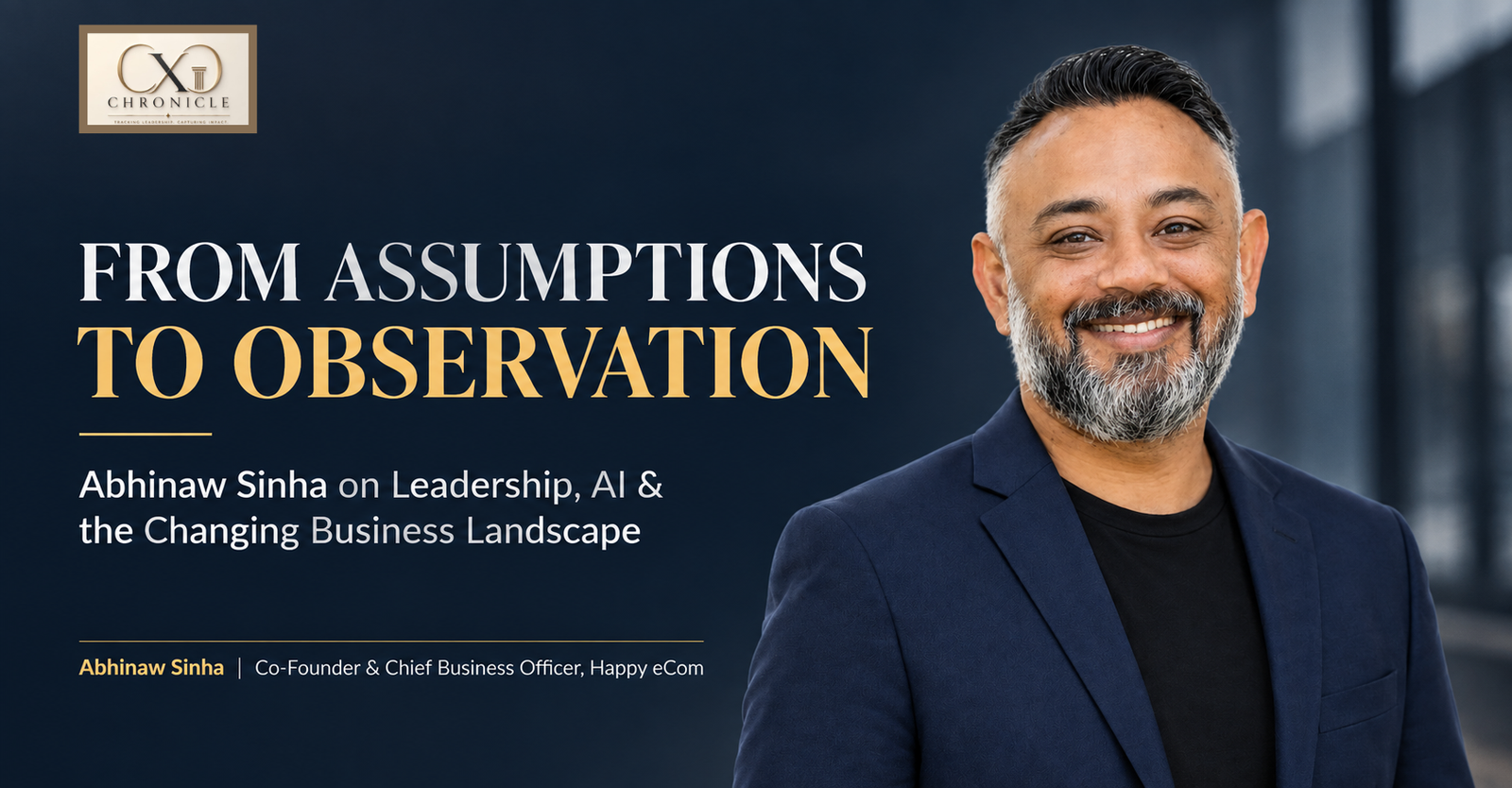
The Happy eCom Co-Founder & Chief Business Officer on leadership lessons from 17-plus years across e-commerce, retail and distribution, the growing role of AI in commercial decisions, and why omnichannel is reshaping the customer journey.
With more than 17 years of experience spanning e-commerce, retail, distribution and commercial leadership, Abhinaw Sinha has worked across organisations including Samsonite India, Snapdeal, Samsung, Safari Industries, Haier and LG Electronics.
Now serving as Co-Founder & Chief Business Officer at Happy eCom, Sinha is focused on brand partnerships, marketplace expansion, brand onboarding and building scalable capabilities for brands operating across Indian and global e-commerce marketplaces.
In a conversation with CXO Chronicle, Sinha reflects on the experiences that shaped his leadership approach, the value of working across multiple commerce formats, the growing role of AI in business decisions, and the evolution of consumer behaviour in an increasingly omnichannel market.
“Experience should help us ask better questions, not stop us from looking at the facts.”
1. Looking back at your professional journey, which experiences or transitions have played the biggest role in shaping your leadership approach?
Two things stand out from my 17-plus years of career.
First, having a strong mentor early on. At that stage, you’re still learning how business really works — not the classroom case studies, but the real one, with distributors, retailers, and numbers that don’t forgive mistakes. Having a senior person shape how I thought, not just what I did, made a huge difference. Even today, the questions I ask my team before we decide something, not after, come from that early guidance.
Second, getting real ownership early — not just tasks to finish, but results to answer for. You stop trying to look good in a meeting and start focusing on what actually moves the number. That shift — from being judged on effort to being judged on results — is, I believe, what shapes a leader the most.
2. You have worked across e-commerce, retail, distribution and commercial leadership. How has this diverse experience influenced the way you approach business and growth?
Honestly, it’s been the most useful asset in my career, more than any single functional experience. I had to build breadth across marketplaces, general trade, exclusive brand outlets, and D2C — and each one teaches you something the others don’t.
E-commerce teaches you speed, data granularity, and how quickly a pricing or ranking decision shows up in a sales chart. General trade teaches you patience, relationship economics, and the reality that a distributor’s margin structure is as much a strategic lever as your marketing spend. EBOs teach you brand experience and control. D2C teaches you that the customer relationship itself is the asset.
What this breadth really does is sharpen your sense of nuance — the same customer behaves differently depending on where they’re standing when they buy from you, and the price proposition, service expectation, and even the trust signals they need are completely different.
3. As technology and AI continue to reshape businesses, what changes are you observing in the way companies approach customers, commerce and growth?
The biggest shift is from hunch-led decisions to observation-led action.
Commercial choices around inventory, SKU prioritisation, and pricing were traditionally guided by experience and judgment, supported by data. Today, AI-enabled tools help businesses read real-time demand signals and respond more accurately.
The most visible benefit is improved working capital: smarter demand and inventory planning allows brands to maintain leaner inventories, reduce overstocking, and release capital previously tied up in warehouses and unsold products.
AI is also improving operational efficiency, with applications such as content creation, customer-service automation, vendor reconciliation, and real-time inventory corrections contributing to profitability and stronger business performance across businesses.
4. What is one leadership lesson or professional perspective that has remained particularly valuable to you throughout your career?
One professional perspective that has become increasingly valuable to me is the importance of replacing assumptions with observation.
Earlier in my career, many commercial decisions were shaped by experience, market understanding, and gut feel. These remain valuable, but I have learned that experience should help us ask better questions, not stop us from looking at the facts.
Today, businesses have access to more data and better tools than ever before, allowing us to observe actual customer behaviour and respond to real demand signals across inventory planning, product selection, pricing, and marketplace performance.
This has influenced how I approach decision-making: combining experience-based judgment with data and questioning assumptions.
For me, leadership is not about having all the answers, but creating a culture where teams stay curious, test their thinking, and respond to what the business and customer are actually telling them.
Good judgment becomes stronger when it is supported by good observation.
5. Looking ahead, which trends or developments do you believe will have the most significant impact on the e-commerce and retail ecosystem?
Without question, omnichannel — and I’d go further and say we haven’t even seen it played out properly yet, especially in India.
Consumer buying behaviour has become genuinely non-linear. A customer might discover a product on Instagram, check it on a marketplace, and still want to touch and try it before buying — or the reverse. This isn’t a niche pattern anymore; it’s becoming the default journey.
Industry commentary backs this up consistently: Walmart India’s former CEO Krish Iyer put it plainly when he said pure play format is passé and omnichannel is the way forward.
For brands and businesses, this means the strategic question isn’t “online or offline” anymore — it’s how to build one integrated shopping journey where inventory, pricing, and customer experience are consistent regardless of where the customer enters or exits.
Businesses that keep treating channels as separate P&Ls rather than one continuous journey are going to find themselves structurally behind in the next few years.
Closing
Across Sinha’s responses, one theme consistently emerges: the role of experience is evolving rather than disappearing. His view is that experience remains important, but its value increases when it is combined with observation, data and a willingness to question established assumptions.
That perspective extends from leadership and decision-making to the broader commerce landscape, where AI, marketplace ecosystems and increasingly non-linear customer journeys are changing how brands approach growth.
For Sinha, the shift is ultimately about understanding what the customer and the business are actually signalling — and making decisions accordingly.
— CXO Chronicle