As connected devices become central to business operations, the convergence of telecommunications, endpoint management, cybersecurity and artificial intelligence could reshape how enterprises manage their technology ecosystems.
By CXO Chronicle | Based on insights shared by Sunil Sankaramanchi, CEO at Wenable inc
For decades, enterprise telecommunications was built around a straightforward objective: keeping devices connected. A SIM card connected to a network, and the network provided the coverage businesses needed to operate.
But the enterprise environment has changed significantly.
Today, organizations rely on tablets inside commercial vehicles, rugged devices in warehouses, retail kiosks, healthcare endpoints, IoT gateways, cameras, point-of-sale systems, industrial equipment and AI-enabled devices operating beyond traditional corporate boundaries.
As these environments expand, connectivity alone is no longer enough. Enterprises must also ensure that their devices remain secure, manageable, observable and operational.
This shift is creating a new opportunity for telecom operators: moving beyond connectivity to become more deeply involved in enterprise operations.
Connectivity Is Evolving Into an Intelligent Service
Developments across the US telecom market illustrate how this transition is taking shape.
AT&T is exploring the convergence of connectivity, edge computing and AI to help enterprises turn data from connected environments into operational insights. Its Connected Spaces initiative brings together equipment, sensors, cameras, connectivity, Azure and AI within an intelligent edge architecture.
T-Mobile’s enterprise offerings extend into private and hybrid networks, network slicing and specialized 5G applications. Meanwhile, the evolution of eSIM technology is making connectivity increasingly programmable. AT&T’s Global SIM Advanced, for example, supports multiple wireless-provider profiles and automated switching between approved networks.
Together, these developments point toward a broader transformation. Connectivity is becoming software-defined, increasingly intelligent and more closely integrated with security and operational management.
As these capabilities converge, the traditional boundaries between telecommunications, endpoint management, IoT and cybersecurity are beginning to blur.
From Device Management to Business Operations
Real-world deployments demonstrate why this evolution matters.
Consider a transportation company managing tablets installed inside commercial vehicles. From an IT perspective, these devices may initially appear to be a conventional mobile device management requirement.
However, the operational priorities are much broader.
Businesses need to know whether a driver has missed a weigh station, whether a vehicle is approaching a low-clearance bridge, whether speeding or harsh braking has occurred, and whether a vehicle has entered or exited a designated geofence. They also need visibility into device health so that potential issues can be addressed before they become safety incidents, fines or service disruptions.
In one US transportation deployment described by Sunil Sankaramanchi, connected devices evolved into a source of real-time operational alerts covering weigh stations, low bridges, speeding, harsh braking, geofences and other fleet events.
The endpoint was no longer simply a device to manage. It had become part of the operational control system.
A similar pattern emerged in the energy sector. A gas-detection company needed specialized field equipment deployed internationally, supported by a custom mobile application and centrally managed deployment, application controls and connectivity. More than 400 systems were deployed across five countries.
In both cases, the underlying requirement extended beyond traditional mobile device management. It involved the combined management of devices, applications, connectivity, security and operations.
These examples reflect a broader pattern across transportation, government, field services, healthcare and industrial environments. Although workflows differ, organizations increasingly need to connect, secure, manage, observe, support and automate their technology ecosystems.
Sankaramanchi’s account of the US telecom and channel ecosystem also describes engagement with 47 active accounts across 19 industry sectors, highlighting the breadth of environments in which this convergence is relevant.
Why Artificial Intelligence Changes the Equation
Artificial intelligence introduces another significant dimension to enterprise mobility.
Much of the discussion around AI and mobile devices focuses on assistants and copilots. However, a larger opportunity may lie in integrating AI directly into the management and security layers that oversee enterprise endpoints.
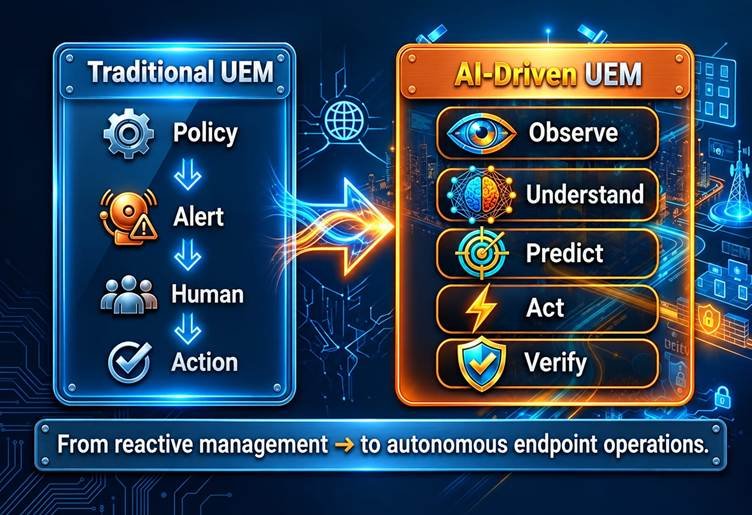
Traditional Unified Endpoint Management (UEM) systems generally operate through predefined policies. An administrator establishes a rule, the system identifies a violation, and a human determines the appropriate response.
This approach becomes increasingly difficult to sustain as organizations manage tens of thousands of endpoints across multiple operating systems, countries, carriers, applications and business workflows.
An enterprise operating 100,000 connected endpoints could generate millions of telemetry signals. Expecting human teams to continuously interpret every signal and identify relationships across the environment is not practical at that scale.
AI could help change the operating model from:
Policy → Alert → Human Decision → Action
to a more adaptive process:
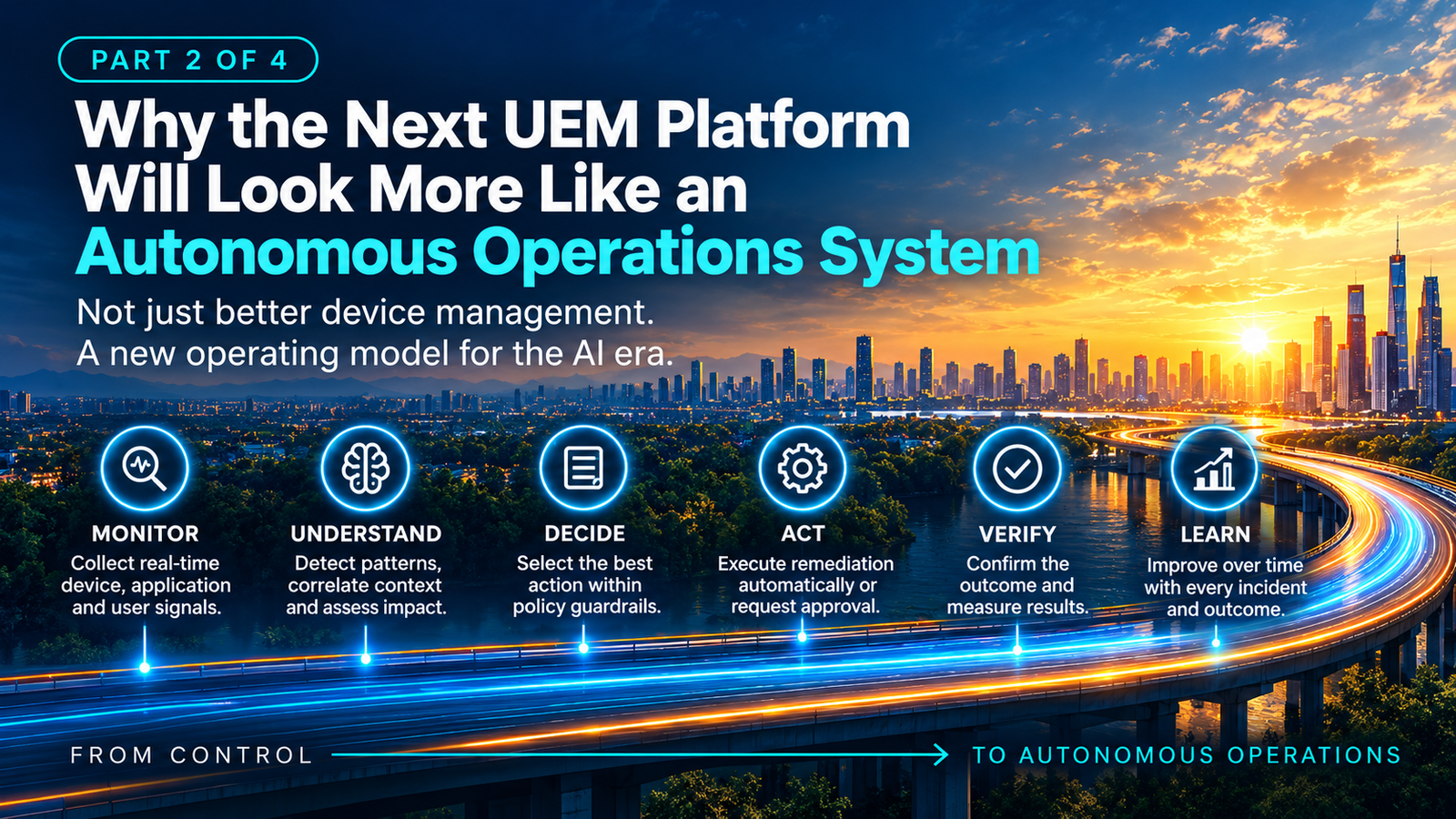
Observe → Understand → Predict → Act → Verify
Such a model would allow management systems to do more than report policy violations. They could interpret patterns, identify potential causes, predict failures and, within appropriate safeguards, initiate corrective action.
The Emergence of Autonomous Endpoint Operations
Imagine a field tablet suddenly consuming substantially more data than other devices performing the same function.
A conventional management platform may flag the increase in usage. An AI-enabled platform could investigate the context behind it.
Did an application update cause the change? Is an application behaving abnormally? Could the device be compromised? Is a process repeatedly failing? Is the device switching between networks? Is an unauthorized AI application being used? Does the activity resemble the behaviour of other devices that later experienced failures?
Over time, such systems could also determine whether a problem can be corrected safely without waiting for an administrator.
The opportunity is therefore larger than adding AI dashboards or chatbots to existing management platforms. It is about developing more autonomous endpoint operations, where intelligence supports the detection, diagnosis and resolution of problems.
Security Must Become Continuous
AI may help enterprises manage endpoints more effectively, but it also introduces new security considerations.
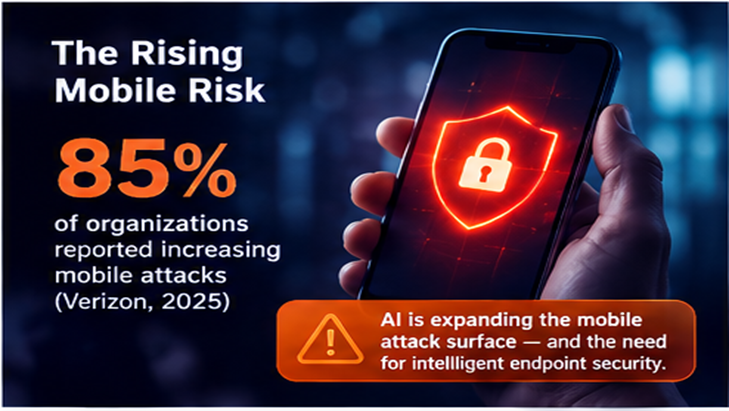
The 2025 Verizon Mobile Security Index, cited in Sankaramanchi’s original article, reported that 85% of surveyed organizations were seeing mobile-device attacks increase. The article also highlights concerns around employees accessing generative AI services from mobile devices and potentially exposing sensitive or proprietary information.
In this environment, checking whether a device complies with a static policy may not be sufficient.
Organizations increasingly need to understand what devices are doing, what data is leaving them, which AI services are being accessed, whether behaviour has changed and whether a device should continue to have access to a particular resource.
This points toward continuous trust assessment, in which device behaviour, security signals and access decisions are evaluated together.
As a result, UEM is positioned to become a more integral part of enterprise cybersecurity rather than serving only as an IT administration tool.
The Strategic Opportunity for Telecom Operators
Telecom operators already have several capabilities that are important to this emerging model. They maintain connectivity relationships, support SIM identity, operate networks, manage large device populations and maintain enterprise billing relationships. Many are also expanding into edge infrastructure, private networks, IoT platforms and security services.
Combining these capabilities with endpoint management and intelligence could enable a broader enterprise proposition.
Instead of providing only a SIM and data connection, telecom ecosystems could offer an integrated combination of connectivity, device management, security, support, intelligence and automation.
Some elements of this convergence are already visible. AT&T’s IoT Console provides a centralized interface for managing IoT connectivity across networks, while its IoT Network Intelligence offering provides device-level network performance indicators, including signal strength, throughput and latency, to support troubleshooting.
A logical next step is to bring network intelligence and endpoint intelligence closer together.
A device has information about its own health and behaviour, but it may not fully understand the network conditions affecting it. The network can provide connectivity insights, but it may not have complete visibility into the device or its applications.
Combining these perspectives could give enterprises a more complete understanding of what is happening across their connected environments.
Bringing Network and Endpoint Intelligence Together
Consider a business application experiencing poor performance on an enterprise device.
The application team may investigate the software. The device team may check the endpoint. The carrier may examine network conditions, while the security team looks for unusual activity. The process can involve multiple teams before the underlying issue is identified.
An AI system that correlates device health, application telemetry, network quality, SIM status, location, security posture, historical behaviour and patterns across similar endpoints could help narrow down the cause.
For example, it might identify that the application and device are functioning normally, but signal quality deteriorated in a particular geographic area, causing repeated network-mode changes. It could also detect that dozens of other devices are experiencing the same pattern.
This type of cross-layer analysis sits at the intersection of telecommunications, endpoint management and AI-driven operations.
The potential value lies not simply in collecting more data, but in connecting information that has traditionally been examined by separate teams and systems.
Endpoints Are Becoming Business-Critical Assets
The growing importance of connected devices changes the way enterprises should think about endpoint management.
A tablet used by a truck driver can affect logistics. A nurse’s device can influence patient workflows. A warehouse scanner can affect order fulfilment. A gas-detection device can contribute to worker safety, while a government tablet may support citizen services.
When these endpoints stop functioning, the business processes that depend on them can also be disrupted.
The objective of endpoint management therefore extends beyond enforcing passcodes, installing applications or maintaining configuration policies.
It increasingly involves keeping business processes running securely and reliably.
That shift creates a broader role for endpoint intelligence, particularly as organizations connect more specialized devices and rely on them for operationally important tasks.
From UEM Toward Autonomous Operations
The evolution of endpoint management has progressed through several stages. Mobile Device Management (MDM) gave organizations greater control over mobile devices. UEM expanded management across different endpoint types. Zero Trust brought device posture into access decisions.
AI could represent another stage in that evolution.
Future systems may increasingly detect anomalies before administrators notice them, predict failures, correlate device and network behaviour, recommend remediation and eventually resolve selected issues autonomously within carefully defined security guardrails.
The administrator’s role could consequently shift from managing individual policies and alerts toward governing the intelligence that manages the broader endpoint environment.
Achieving this will require careful implementation, security controls and appropriate oversight, but the direction points toward more adaptive and context-aware management.
The Future of Enterprise Telecom Is About More Than Connectivity
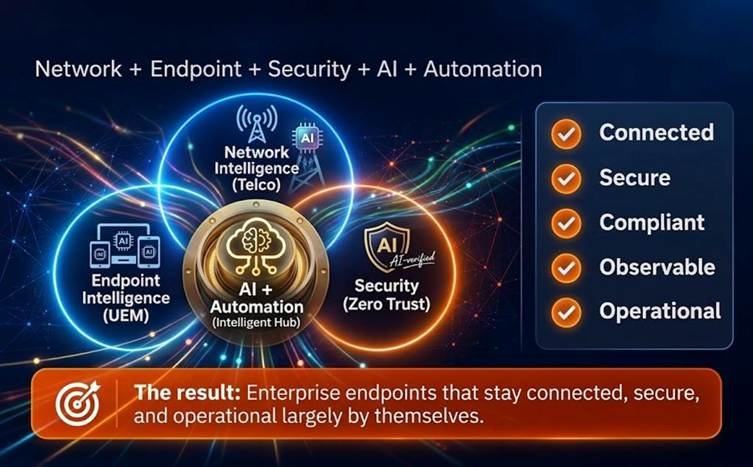
Telecommunications helped create the connected enterprise. Its next opportunity may be helping enterprises operate the environments they have connected.
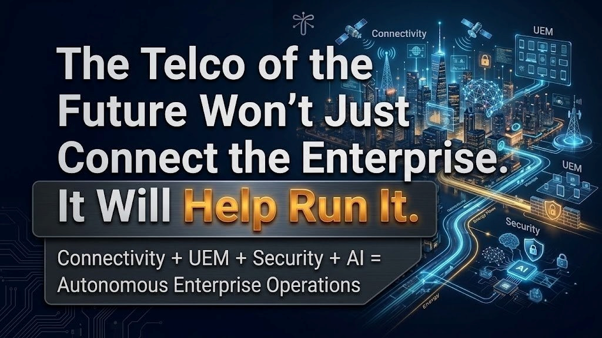
The convergence of networks, endpoints, security, AI and automation could reshape how organizations manage their technology infrastructure.
The underlying components already exist in various forms: devices generate telemetry, UEM platforms provide management controls, networks provide connectivity intelligence, security systems contribute trust signals, and AI can help interpret information and support decisions.
The challenge is bringing these capabilities together into a coherent operating model.
As that convergence advances, enterprise technology may gradually move away from treating every endpoint as an individual device that requires constant manual management. The expectation could instead become that connected endpoints remain secure, compliant, observable and operational with increasing levels of automation.
For telecom operators and enterprise technology leaders alike, the opportunity extends beyond connecting devices. It is about enabling the business operations that depend on them.
About the Source
This article is based on insights shared by Sunil Sankaramanchi, CEO at Wenable inc, in his original article, “The Telco of the Future Won’t Just Connect the Enterprise. It Will Help Run It.”
WinnoFusion Technology
Original article: https://www.linkedin.com/pulse/telco-future-wont-just-connect-enterprise-help-run-sankaramanchi-ddvse/
Editorial note: This article has been adapted for CXO Chronicle from the original source. The views and examples attributed to Sunil Sankaramanchi reflect the source article.
CXO Chronicle
Tracking Leadership. Capturing Impact.