Vibha Sarin Prabhakar, Chief Growth & Experience Officer at IGEN, on navigating transformation, connecting business ecosystems, the responsible use of AI, and the evolving role of leadership.
With more two plus decades of leadership experience spanning global corporations, banking, digital businesses and emerging platforms, Vibha Sarin Prabhakar has built her career across very different business environments.
Now appointed Chief Growth & Experience Officer at IGEN – India Global Expo News, Vibha joins the Circle One Leadership team at an important stage in the organisation’s growth journey.
Her experience across GE, Convergys, ICICI Bank, ABN AMRO, RBS, MMTC-PAMP, eJOHRI and Shriram Automall has given her a cross-functional perspective spanning growth strategy, customer experience, operations, digital transformation, brand and business leadership.
For Vibha, however, the defining moments of her career have not necessarily been individual roles, but the transitions between different environments — and the lessons those transitions created.
In this conversation with CXO Chronicle, she reflects on the leadership experiences that shaped her, why growth and customer experience must operate as one business engine, the opportunity to build a connected ecosystem through IGEN, the role of AI in business decision-making, and why the next chapter of leadership will be increasingly about building ecosystems and enabling others to build.
1. In your new role as Chief Growth & Experience Officer at IGEN, you are joining at an important stage of its growth journey. What are the key opportunities you see in building an ecosystem that connects businesses, CXOs, founders, SMEs, institutions and global opportunities?
What excites me most is that I don’t see IGEN as just another event or media platform. I see the opportunity to build an ecosystem where business, knowledge, leadership, technology, media and opportunity come together.
One of the biggest challenges in a country as large and diverse as India is that knowledge, businesses, experts, CXOs, SMEs and opportunities are often fragmented. IGEN has the potential to make those connections more discoverable, meaningful and outcome-oriented.
One of the ideas I find particularly powerful is SSO — Sector Session Outcome. It is a new format designed differently from a conventional conference: 60 GDP-impacting sectors, focused one-hour sessions, across multiple halls, with every session designed to produce a defined outcome rather than simply a discussion.
The focus is on creating three tangible knowledge and business outcomes from these conversations:
- Policy Reports — capturing sector insights and recommendations that can contribute to policy dialogue and influence.
- Future Business Reports — identifying market intelligence, emerging opportunities, business trends and future growth possibilities.
- Company Leadership Reports — capturing leadership, innovation, best practices and benchmarks emerging from each sector.
What makes this opportunity even more powerful is the ability to ensure that every meaningful sector conversation creates an intellectual and knowledge asset beyond the session itself.
The insights, expert perspectives, industry discussions and outcomes can be transformed into original content, sector-specific white papers, market reports and leadership reports. These can then be distributed through India Global News, creating a continuous knowledge and intelligence layer around each sector.
So the journey becomes:
Sector Conversation → Insights → SSO Outcome → Knowledge Assets → India Global News → Wider Industry & Policy Visibility → Action & Impact.
And that, for me, is where the larger purpose comes in. If we can systematically capture what India’s industries, businesses and leaders are saying, identify the opportunities and challenges emerging sector by sector, and convert those insights into credible knowledge assets, we can create a meaningful feedback and influence mechanism between industry, markets and policymakers.
Ultimately, I see this contributing to the larger Viksit Bharat 2047 vision — not by simply creating conferences, but by creating a continuously evolving body of sector knowledge, market intelligence and original Indian business content that can inform conversations, influence thinking and contribute to better policy and business outcomes.
That is what makes the opportunity exciting for me: building an ecosystem where conversations don’t end in a conference room — they become knowledge, knowledge becomes influence, and influence contributes to India’s journey towards Viksit Bharat 2047.
2. You have built a 20+ year leadership journey across organisations such as GE, Convergys, ICICI Bank, ABN AMRO, RBS, MMTC-PAMP, eJOHRI and Shriram Automall. Looking back, what experiences or transitions have shaped your leadership approach the most?
I don’t think there was one defining role. It was the transitions between very different environments that shaped me.
My early years at GE and Convergys taught me discipline, process orientation and what it means to operate in a large global organisation. Banking — through ICICI, ABN AMRO and RBS — taught me something equally important: that behind every process is a customer, a risk and a business consequence.
The biggest shift came when I moved from managing within established organisations to building and transforming businesses. At MMTC-PAMP, eJOHRI and later Shriram Automall, I had to look at the entire picture — customer, technology, operations, people, brand, revenue and ultimately the P&L.
For example, my experience with MMTC-PAMP gave me the opportunity to work on business transformation almost from scratch — building processes, capabilities, customer experience and the operating model as the business evolved and expanded into both B2B and B2C retail.
And perhaps the most important lesson has been this: leadership is not about having all the answers. It is about creating clarity when the situation is ambiguous, bringing people together and having the courage to take ownership.
Today, I see myself less as a functional leader and more as a builder and problem-solver.
3. Your experience brings together growth strategy, customer experience, operations, digital transformation and brand leadership. How do you see these areas coming together to create sustainable business growth in today’s rapidly changing business environment?
I don’t see these as separate functions. I see them as different parts of the same business engine.
Growth without a strong customer experience is difficult to sustain. Customer experience without commercial thinking can become expensive. Technology without a real business problem is simply a shiny object. And brand without operational delivery eventually loses credibility.
At Shriram Automall, for example, my work brought together customer experience, digital transformation, operations, marketing and business strategy. The objective was not simply to improve experience, but to make experience a business growth engine.
That is how I approach transformation: start with the business objective and customer problem, use technology intelligently, enable the organisation to deliver, and ensure the brand promise is actually experienced by the customer.
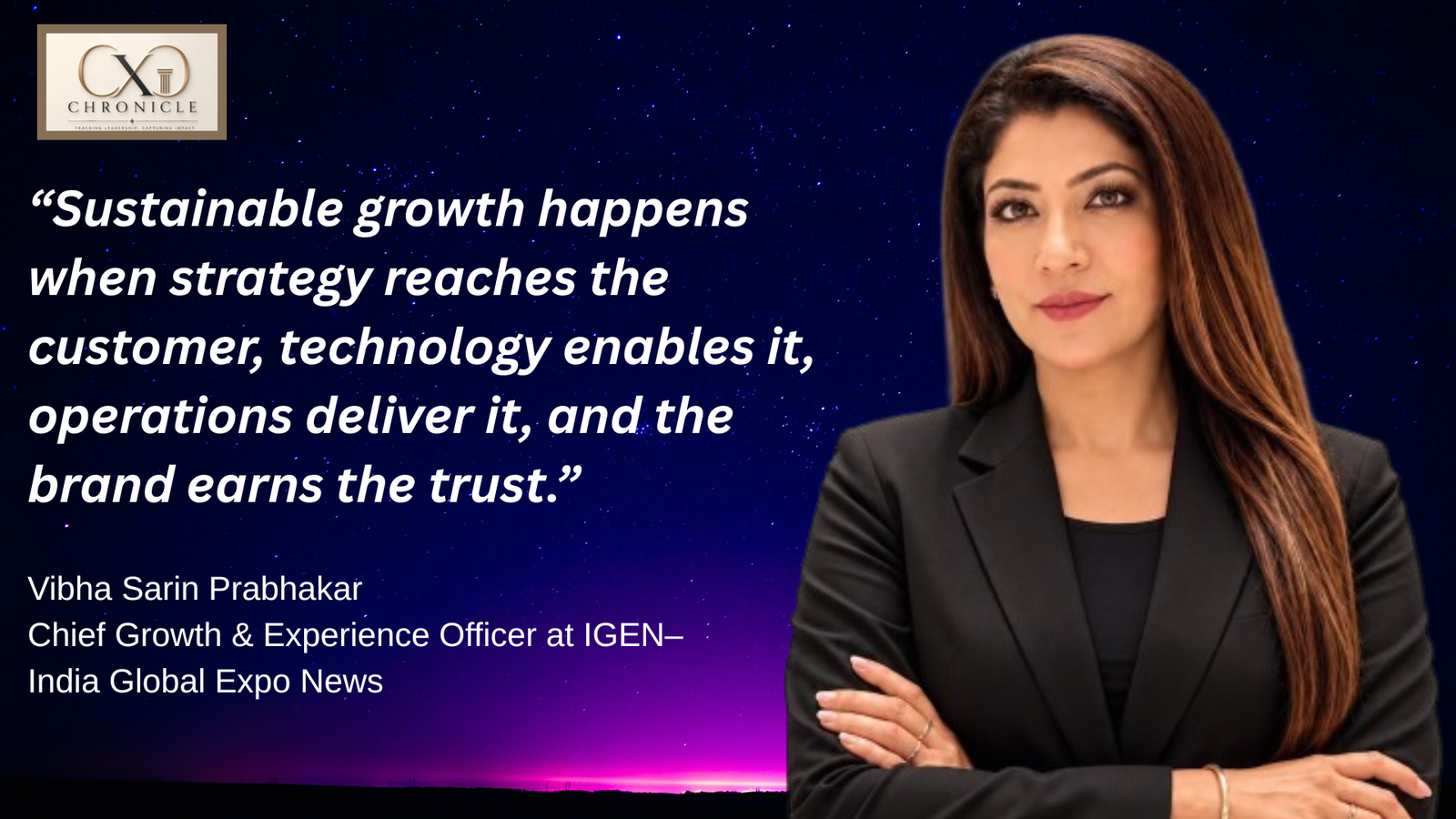
For me, sustainable growth happens when strategy reaches the customer, technology enables it, operations deliver it, and the brand earns the trust.
“Leadership is not about having all the answers. It is about creating clarity when the situation is ambiguous, bringing people together and having the courage to take ownership.”
— Vibha Sarin Prabhakar
4. With AI rapidly becoming part of business strategy, customer experience and digital transformation, how do you see AI changing the way organisations approach growth and customer engagement? Based on your experience, where do you see the most meaningful opportunities for businesses?
I believe the biggest opportunity for AI is not replacing people, but helping people make better decisions, faster.
The question should not simply be, “Where can we use AI?” It should be, “What business or customer problem can AI solve better?”
The opportunities are enormous — from customer intelligence and personalisation to predictive decision-making, process automation, employee productivity and real-time business insights. My experience in the banking world reinforced how powerful technology can be when it is applied to real business problems involving scale, risk, efficiency and customer needs.
But AI cannot replace human judgement, empathy, accountability and trust.
The organisations that benefit most will be those that understand where AI can create disproportionate value, while knowing where human intelligence must remain at the centre.
5. Beyond your corporate leadership journey, you also contribute to the business ecosystem as a Member & Independent Director at the Institute of Directors (IOD), India. As you look ahead, what developments in leadership, governance, technology and business transformation are you watching most closely, and what do you believe will shape the next phase of your leadership journey?
I believe we are going to see an even stronger convergence of technology, governance and human leadership.
AI will change business models, while digital transformation will continue to reshape how organisations operate. At the same time, responsible leadership and governance will become even more important as the speed of change increases.
My experience with the Institute of Directors has reinforced my belief that governance does not slow business down; good governance gives organisations the confidence and discipline to move responsibly.
I also see leadership moving from command-and-control towards purpose, collaboration and ecosystems. The leaders of tomorrow will increasingly have to connect people, organisations, capabilities and opportunities rather than simply manage functions.
For me personally, the next chapter is about moving from managing businesses to building ecosystems, developing people and enabling others to build.
After more than two decades in corporate leadership, I don’t feel I am at the end of my journey. I feel I am entering a different chapter — from managing businesses to building ecosystems, developing people and enabling others to build.
Conclusion:
Vibha Sarin Prabhakar’s career reflects a shift that is increasingly defining modern leadership: moving beyond functional ownership toward cross-functional business building, ecosystem thinking and customer-led transformation.
Her perspective also highlights an important distinction in the AI era — technology may accelerate decision-making, but sustainable growth still depends on judgement, trust, people and execution.
As she begins her next chapter at IGEN, the opportunity extends beyond driving growth. It is about connecting people, knowledge, businesses and opportunities into an ecosystem capable of creating value well beyond individual transactions or events.
-CXO Chronicle