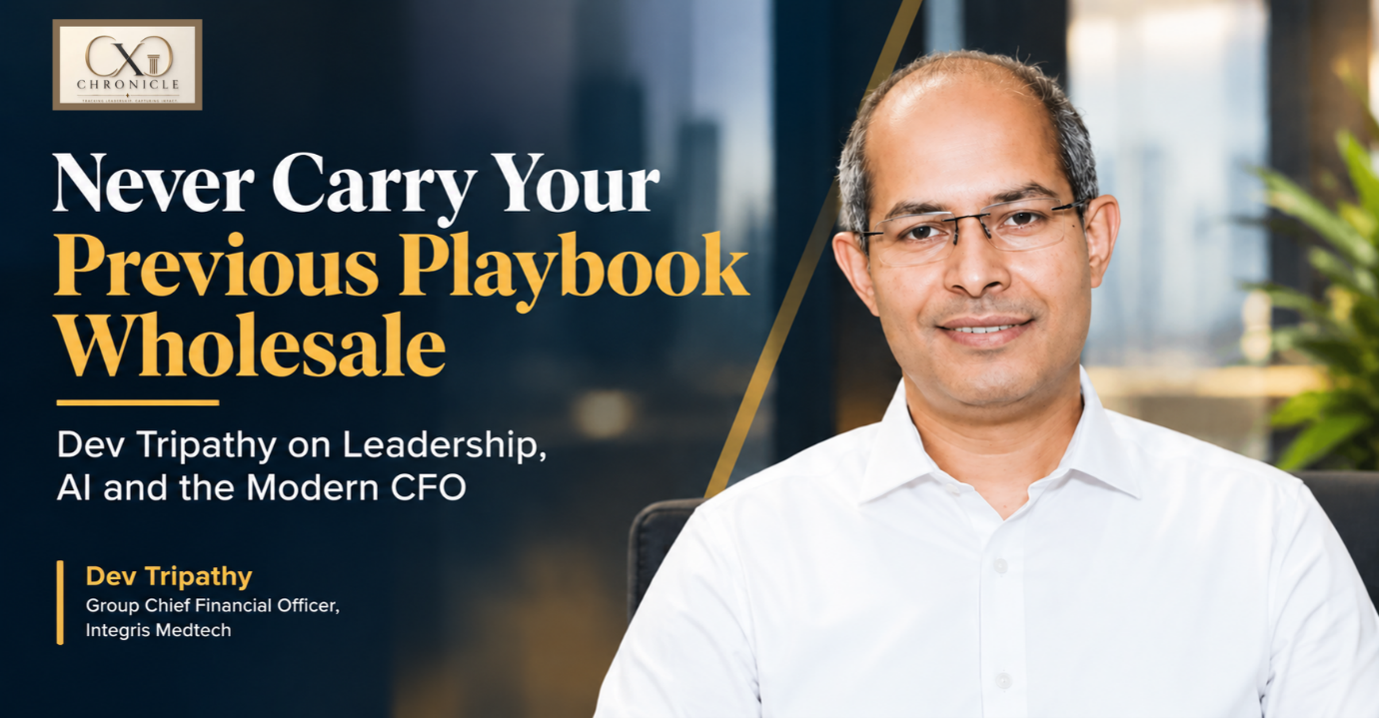
Dev Tripathy, Group Chief Financial Officer at Integris Medtech, shares his perspective on two decades of finance leadership, adapting leadership approaches to organisational context, and the growing intersection of AI, governance and financial transformation.
With more than two decades of experience across finance leadership, business performance, strategic planning, commercial finance and business transformation, Dev Tripathy has built his career at the intersection of finance and business strategy.
He has spent more than 18 years with Philips, most recently serving as CFO for the Indian Subcontinent and Growth Region – Image Guided Therapy. His career at Philips included leadership roles across Health Systems, Personal Health, FP&A, commercial finance and business transformation. Earlier, he held roles with Associated British Foods plc and Tata Steel.
Now serving as Group Chief Financial Officer at Integris Medtech, Tripathy brings experience across finance, healthcare, commercial strategy and transformation to an organisation operating within a rapidly evolving healthcare and medical technology landscape.
In this conversation with CXO Chronicle, Tripathy discusses the experiences that shaped his leadership philosophy, why CFOs increasingly need to operate as strategic advisors, how AI is changing finance and governance, and why leaders must be willing to reshape their playbook when entering a new organisation.
“Never carry your previous playbook wholesale into your next role.”
Looking back at your career journey, which experiences have shaped your approach to leadership the most?
More than two decades in finance have taught me that leadership extends well beyond numbers. It means being a trusted voice at the table on strategy, governance, and people.
Progressing to the CFO role gave me a front-row view of multi-country, multi-business-line operations and the discipline required to govern at scale. I’ve also learned that knowledge alone is no longer the differentiator. It is widely available, and in the AI era, it can be acquired faster and more democratically than ever. The real value lies in aligning objectives across a diversified organisation and delivering against them.
My greatest leadership asset has been learning from leaders at every level — from supervisors to CEOs, as well as people deeply involved in execution on the shop floor.
What I value most is the ability to listen carefully, feel comfortable speaking last rather than first, prioritise competing issues, and define the right problem statement.
Above all, leadership is about making the people around you successful — and creating more leaders.
What has been one of the most meaningful milestones or transitions in your professional journey so far?
Working across organisations at different stages of maturity — mostly established, long-standing ones so far — has taught me not to assume that a model successful at a large multinational will transfer directly to a growth-stage organisation.
The milestone is not really the change in title; it is demonstrating that I could reset my own playbook.
One approach does not suit every organisation, so the playbook must be reshaped around its needs and maturity.
Moving from running an established set-up to building and shaping a fresh, Gen Alpha organisation from the ground up is a transition I’m genuinely excited about.
How are technology and AI influencing your industry and the way organisations approach business today?
I discussed this at an ASSOCHAM Industry Forum on AI, Analytics and the Evolving Role of CFOs in Governance.
In my view, technology, particularly AI, is moving the CFO’s role from reporting steward to real-time strategic advisor. That evolution, however, must be anchored in governance. I describe it through what I call the “F2 lens” — a reference to the F2 key in Excel, which allows you to check the formula behind a cell — covering interrogation, traceability, and logic verification against SEBI-aligned governance pillars.
In medtech, AI is also reshaping regulatory and quality workflows, making robust governance even more important as the sector modernises and seeks to optimise the cost of delivering care.
What leadership lesson or perspective has stayed with you throughout your career?
Never carry your previous playbook wholesale into your next role.
After a long tenure, it can be tempting to rely on what worked before.
Effective leadership means understanding the context you are actually operating in — the company’s stage, culture and regulatory reality — and developing the approach that fits it, rather than defaulting to the familiar.
“The real value lies in aligning objectives across a diversified organisation and delivering against them.”
— Dev Tripathy
Looking ahead, which developments or trends in your industry are you watching most closely?
I’m watching two closely connected areas: India’s IPO-readiness ecosystem for medtech and healthcare companies, and the changing regulatory environment around SEBI, Ind AS, DPDP and EPR compliance.
As more Indian companies move towards the public markets, expectations around governance, AI accountability, and finance transformation are increasing rapidly.
The organisations that view IPO-readiness as a continuous transformation discipline, rather than a checklist to complete before listing, will be best positioned to maintain investor trust.
The CFO Playbook in an AI-Driven Business Environment
Across Tripathy’s responses, one idea repeatedly surfaces: leadership cannot be separated from context.
His experience across large, established organisations has reinforced the importance of adapting rather than simply replicating previously successful models. That perspective also extends to the changing role of finance, where AI is creating new possibilities for real-time insight and strategic decision-making while simultaneously increasing the importance of governance and traceability.
For Tripathy, the modern CFO role sits at the intersection of finance, strategy, technology, governance and business transformation. The challenge is not simply adopting new tools or processes, but understanding how they fit within the organisation’s maturity, regulatory environment and broader business objectives.
— CXO Chronicle